
Tao's main pageiamtaolong.github.io

Artistic Practice Opportunities in CST Evaluations:A Longitudinal Group Deployment of ArtKrit

Catherine Liu*, Tao Long*, Asya Vaisberg, Chau Vu, Jiaju Ma, Jingyi Li

DIS 2026 · Best Paper Honorable Mention (Top 5%)
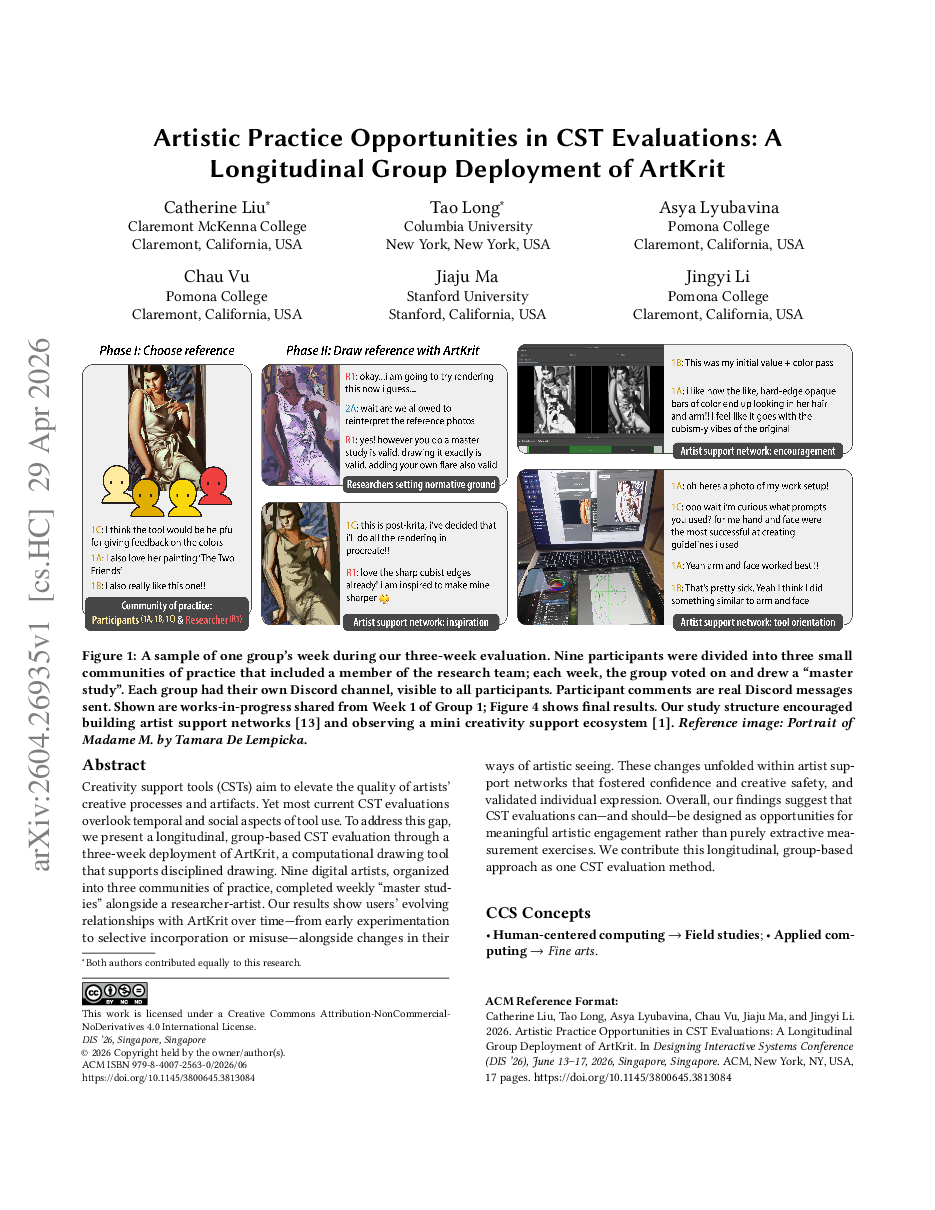
First page of the ArtKrit Longitudinal paper
read the paper ↗

Most creativity support tool evaluations overlook time and community.
— We deployed ArtKrit for three weeks with artists embedded in small support networks.

01 / the gap

1/ Beyond One-Off CST Evaluations

Creativity support tools (CSTs) aim to elevate artists' creative processes and artifacts, yet most evaluations overlook temporal and social aspects of tool use. We ran a longitudinal, group-based evaluation of ArtKrit, a computational drawing tool that supports disciplined drawing.
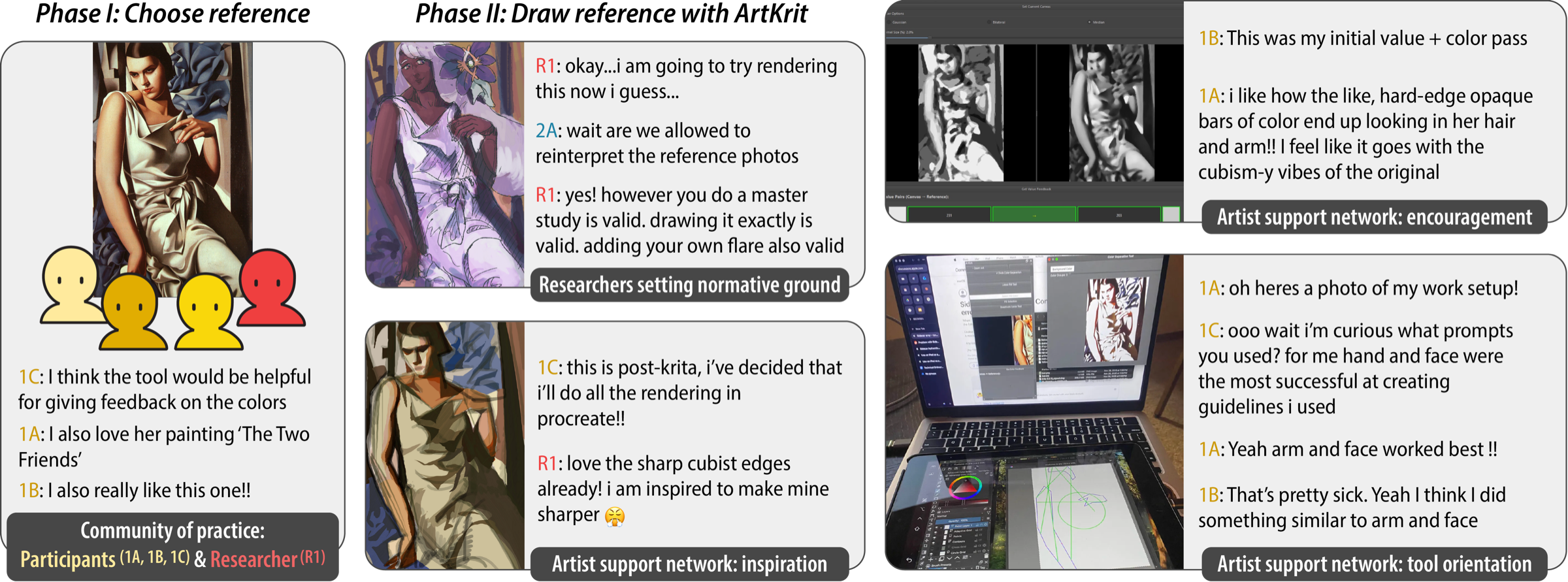

Three communities of practice, one master study a week
Fig. — One Group's Week
Three communities of practice, one master study a week

Each week a group voted on and drew a master study, sharing works-in-progress in their own Discord channel.

  • Nine digital artists were organized into three small communities of practice, each with a researcher-artist as a member.
  • The structure encouraged artist support networks and a mini creativity support ecosystem.
  • The study produced 36 artifacts and over 50 hours of ArtKrit usage data.
Three weeks, weekly master studies
Fig. — Study Timeline
Three weeks, weekly master studies

Overview of the evaluation timeline.

  • Participants used ArtKrit to replicate one master study each week and corresponded on Discord.
  • Mixed methods: interaction logs with canvas snapshots, plus interviews and community discussion.

Summary

Framing the evaluation as an opportunity for meaningful artistic engagement, rather than a purely extractive measurement exercise, shaped both what participants did and what we learned.

02 / findings · RQ1 & RQ2

2/ Three Weeks with ArtKrit: How Use Evolved

Participants' relationships with ArtKrit changed over time, from early experimentation to selective incorporation or even misuse, alongside changes in how they saw their subjects.
Productive friction in a three-hour session
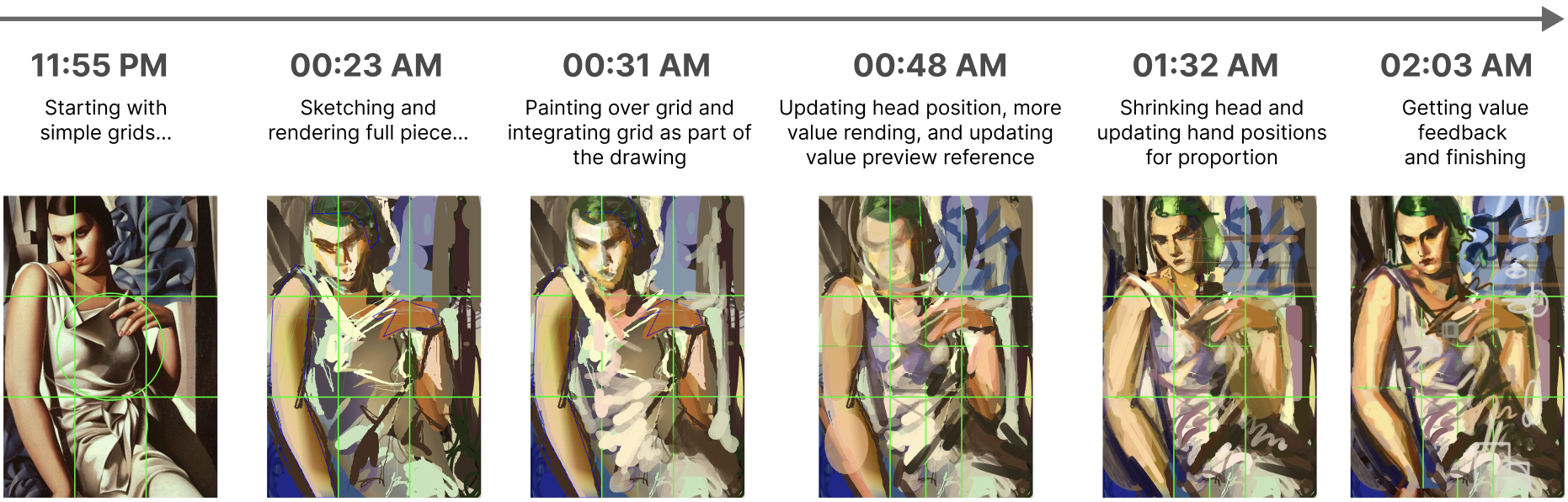
Fig. — A Drawing Session
Productive friction in a three-hour session

Participant 1A's Week 1 session, from grid setup to final rendering.

  • Key actions include sketching, grid integration, updating previews, refining value, and adjusting proportions.
  • Productive friction and dialectical activities characterized how artists worked with, and against, the tool's guidance.
One reference, many artists' interpretations
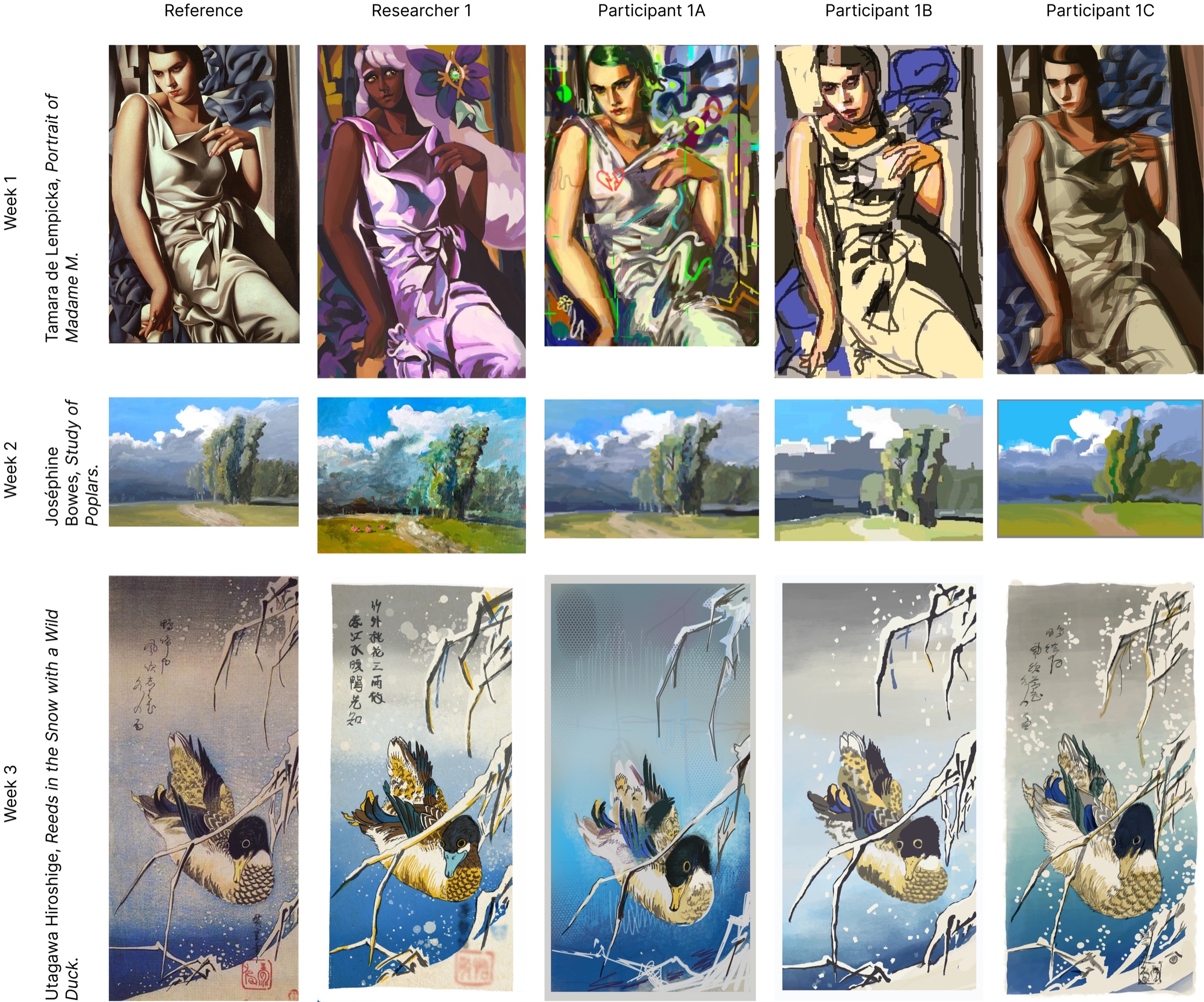
Fig. — Group 1's Drawings
One reference, many artists' interpretations

Reference images (left) and Group 1's drawings, weeks 1–3. References: Tamara de Lempicka, Josephine Bowes, Utagawa Hiroshige.

  • Reference complexity shapes tool use: portraits, landscapes, and prints each pulled participants toward different features.
  • A resulting design implication: integrated simplicity bests novel algorithms.
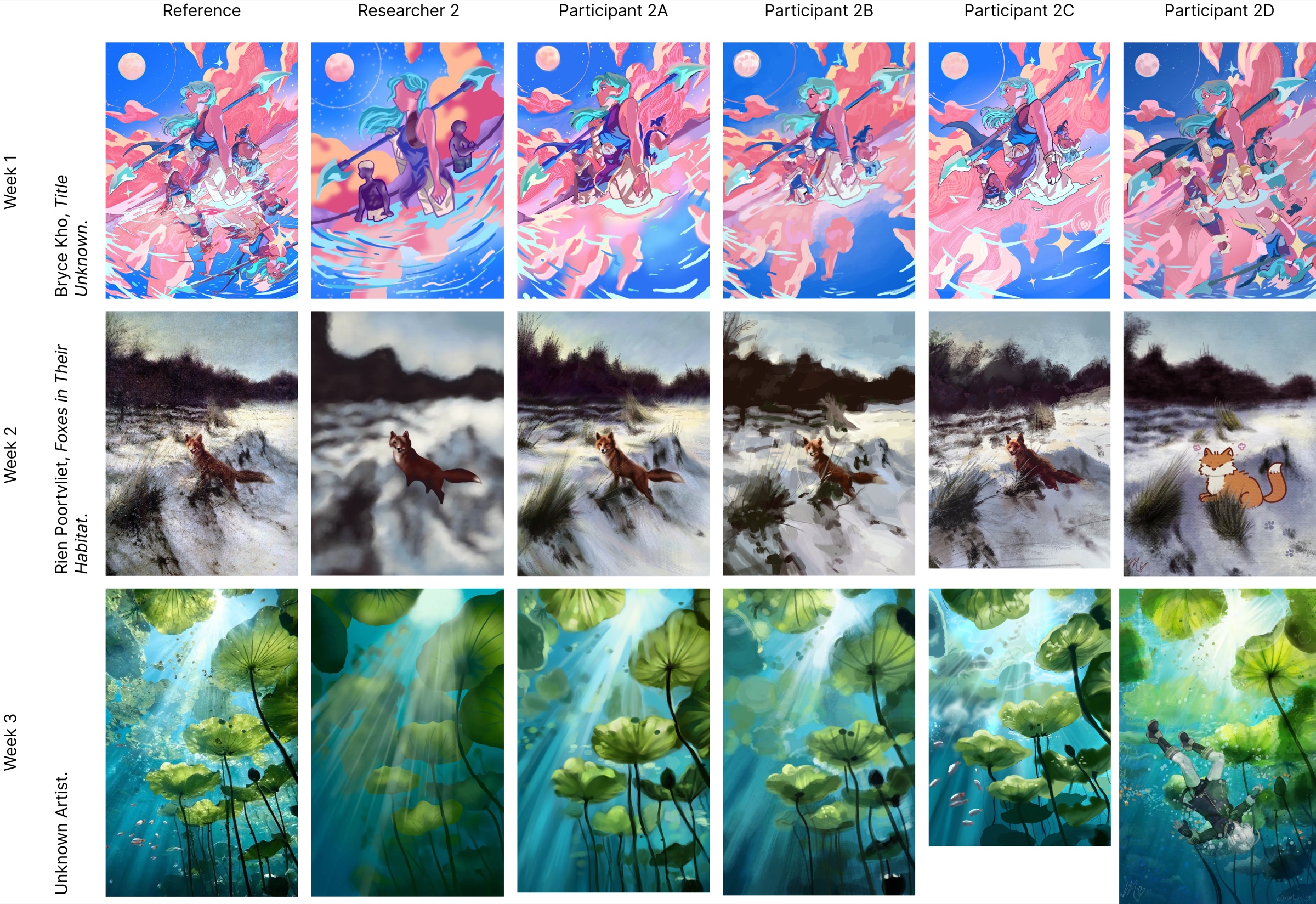
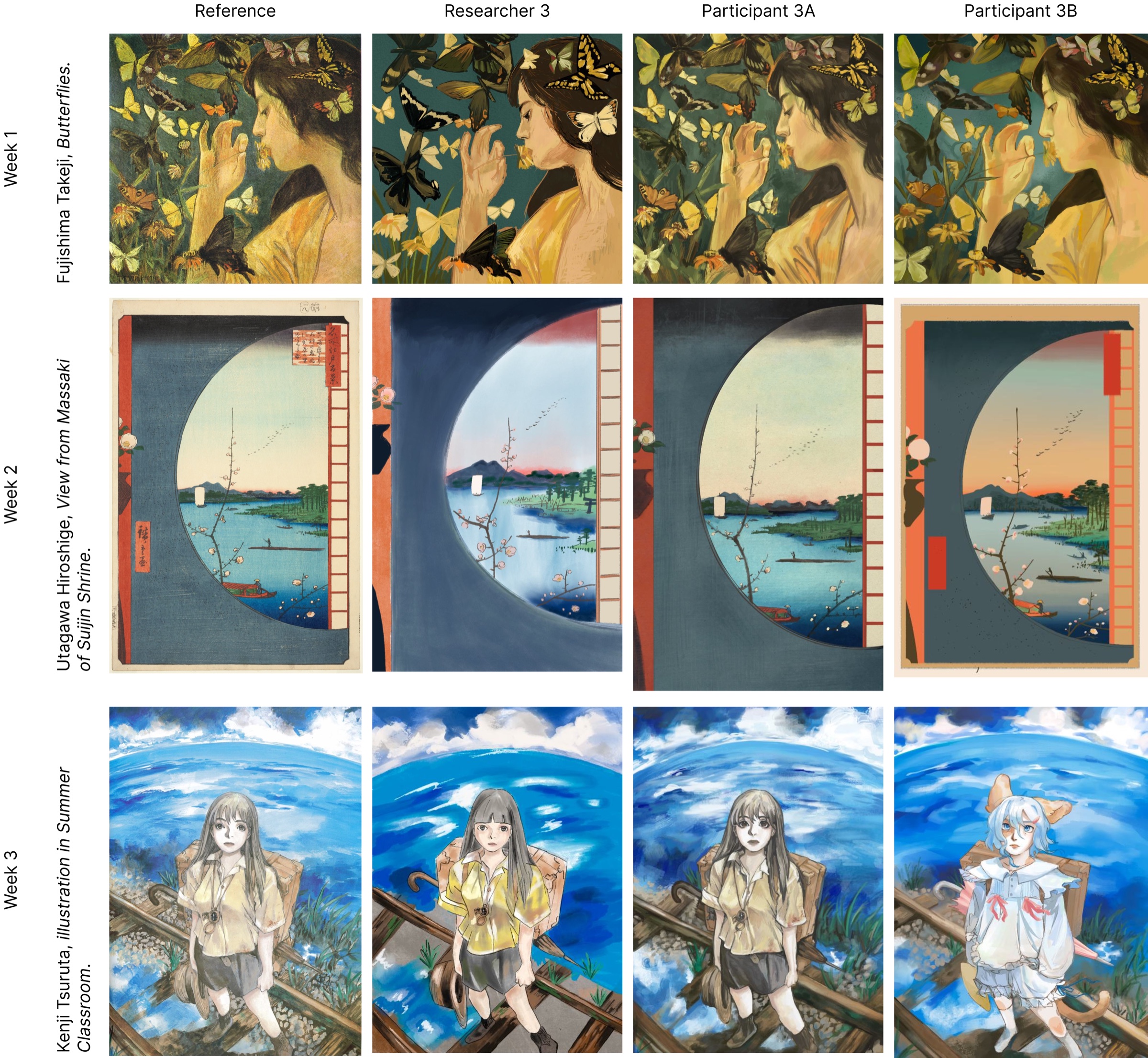
Fig. — Groups 2 & 3
Every group chose its own master studies

Group 2 (left) and Group 3 (right). References include Rien Poortvliet's foxes, Fujishima Takeji's butterflies, and a Hiroshige view of Suijin Shrine.

  • Groups voted on each week's reference, so the art itself, not the tool, set the agenda.
In Their Words — Friction
Taking the tool's advice, or not

When I was using ArtKrit and getting feedback on the colors, I wasn't usually taking it, because I know what colors I like, even though it doesn't match the reference image.

— 1C

ArtKrit made it pretty easy to see all these different aspects of your reference that you wouldn't normally think about.

— 2A

Having [ArtKrit] do [things] for me in a way that fed me my vegetables, I see why this is a nourishing thing to do.

— 1A
From exploration to balanced, targeted use
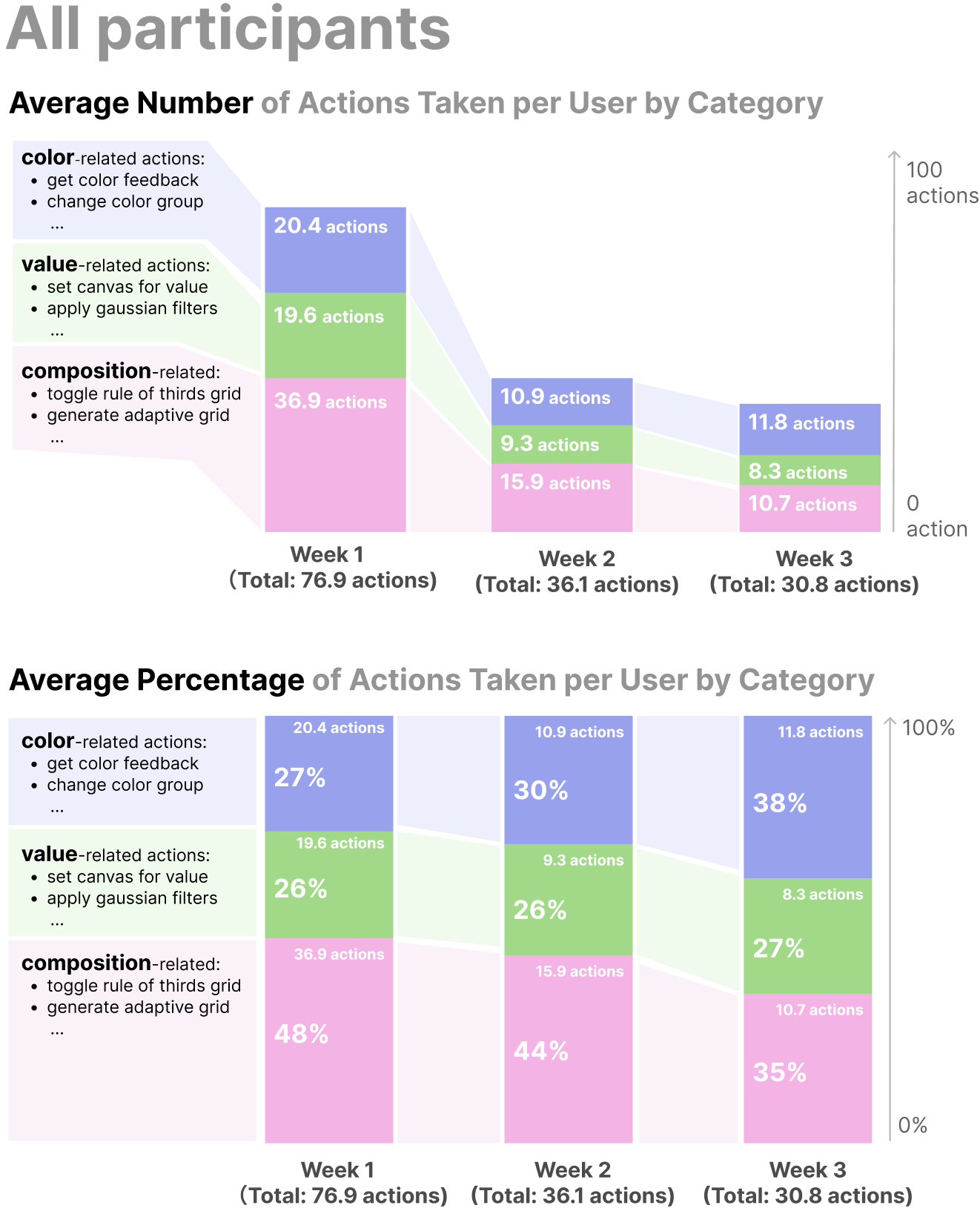
Fig. — Action Counts
From exploration to balanced, targeted use

Average number and percentage of user actions by category (color, value, composition) over three weeks.

  • Early on, participants explored broadly; later they used features in a more targeted way.
  • Use converged toward balanced engagement across color, value, and composition.
  • Some participants engaged in creative misuse, which reaffirms the value of a familiarization phase.

Summary

A tool's value shows up over weeks, not minutes. Expect an exploration phase, plan for selective adoption, and treat creative misuse as a signal about artistic practice.

03 / findings · RQ3

3/ Artist Support Networks & Implications

These changes unfolded inside artist support networks that fostered confidence and creative safety and validated individual expression.
9digital artists
3communities of practice
3 weeksof deployment
36artifacts created
50+ hof ArtKrit usage data
1/wkmaster study per group
Each community developed its own rhythm
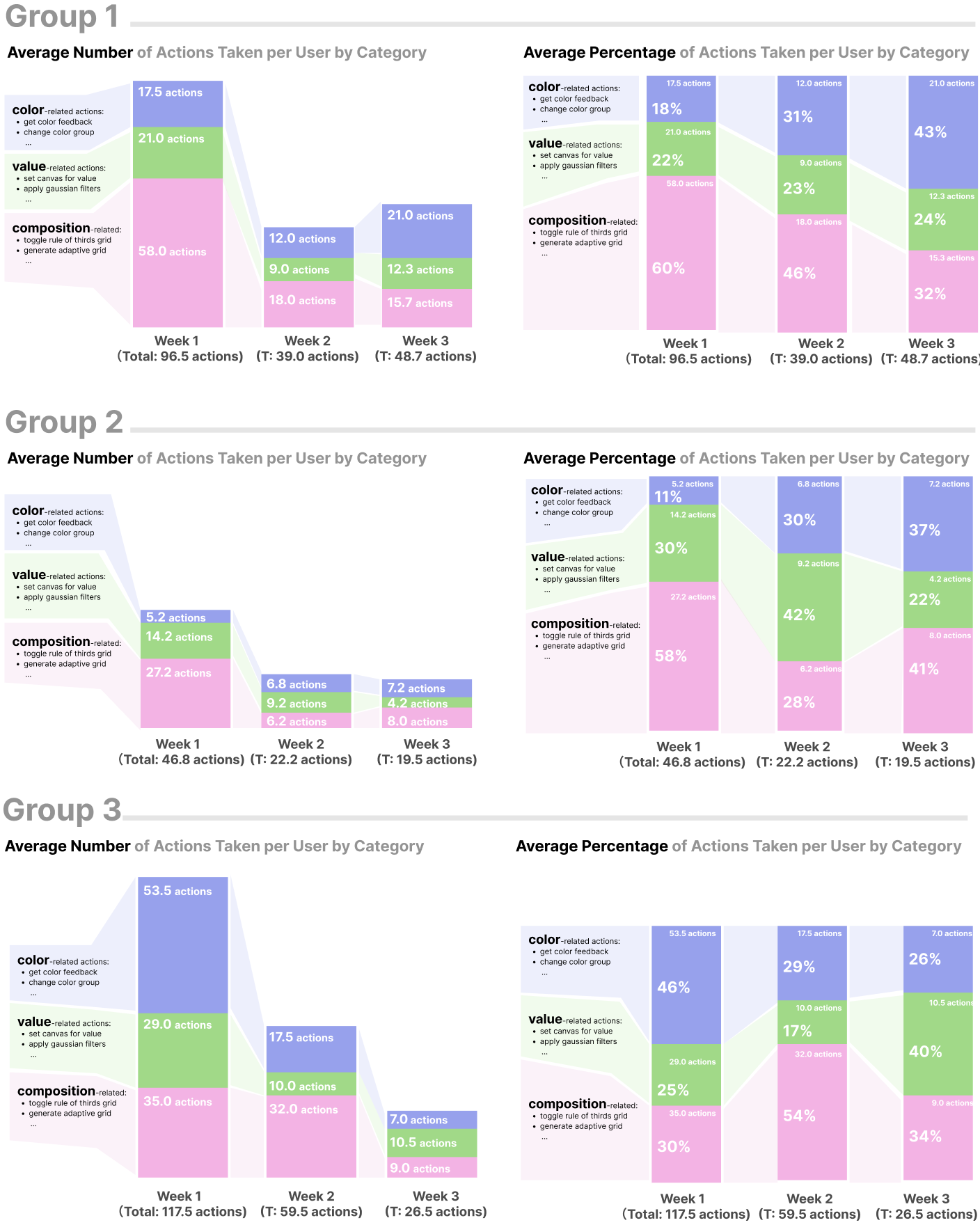
Fig. — By Group
Each community developed its own rhythm

Average number and percentage of user actions by category, by study group.

  • The same three action categories are shown separately for each of the three groups.
  • Each group had its own Discord channel, its own master studies, and its own norms.
In Their Words — Community
Learning from, and with, each other

I definitely picked things up from seeing other people do it, and then I think it also, like, gave me an idea of what quality bar to shoot for.

— 1B

You don't really see the possibilities until you see somebody kind of pushing the possibilities.

— 1A

I had so much fun! I wanna do more studies! I think a Discord group where people make art together is a very good way to do a study!

— 1A
RQ3 — Support Networks
What the community added
  • Emotional well-being: positive interactions and encouragement made experimenting feel safe.
  • Motivation and learning: peers' work and comments drove effort and skill sharing—“not in a pressuring way, but in a co-working sense.”
  • Setting normative ground: group norms about how to use the tool, which must be weighed against biasing participants.
  • Fun: all participants reported enjoying the study.

Takeaways

  • CST evaluations can, and should, be designed as opportunities for meaningful artistic engagement rather than purely extractive measurement.
  • Design for a familiarization phase, then for selective and creative use.
  • A longitudinal, group-based approach is one CST evaluation method that surfaces social and temporal effects that single sessions miss.
cite

BibTeX

If this work is useful to you, here is a citation you can copy.

@inproceedings{liu2026artistic,
author = {Liu, Catherine and Long, Tao and Lyubavina, Asya and Vu, Chau and Ma, Jiaju and Li, Jingyi},
title = {Artistic Practice Opportunities in CST Evaluations: A Longitudinal Group Deployment of ArtKrit},
year = {2026},
isbn = {9798400725630},
publisher = {Association for Computing Machinery},
address = {New York, NY, USA},
url = {https://doi.org/10.1145/3800645.3813084},
doi = {10.1145/3800645.3813084},
booktitle = {Proceedings of the 2026 Designing Interactive Systems Conference},
pages = {2054–2070},
numpages = {17},
location = {Singapore, Singapore},
series = {DIS '26}
}